
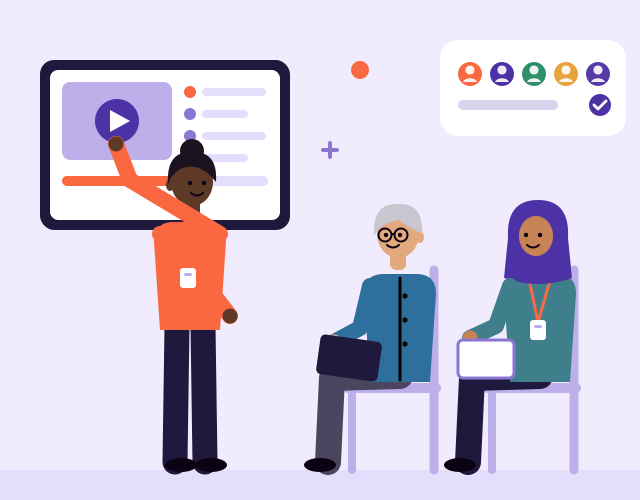
Before you launch: test with a few people, then make it simpler
Small usability tests and simpler forms are two of the cheapest ways to improve a new website, app or digital product before launch. Here is how to do both.
Every project is different, but the shape is the same. You can bring us in at any stage, and you always know what happens next.
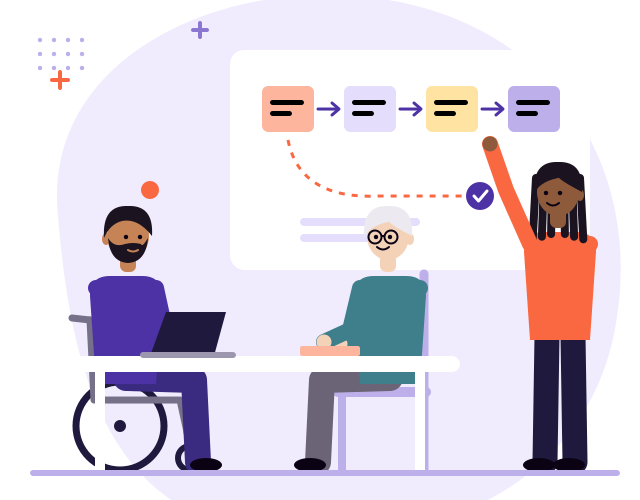
Open a stage to see what happens, what you get and how long it usually takes. Every project is scoped and agreed with you after a free discovery call.
We listen first. We learn about your organisation, your customers, your market and the problem to solve, and we agree what success looks like.
1 to 2 weeks
Discovery: weeks 1 to 2 of about 20
A film that walks through our services and the six stages of a project. Captions are on, and the transcript is below.
Caresque explainer: How we work, in under three minutes Transcript, 2 minutes 44 seconds. Narrator: synthetic female UK voice. Light music under the voice.
Scene 1. Opening (0:00) Narrator: Got an idea, a product or a process that needs to move? Caresque is a UK consultancy and product studio. Here is what we do, and how we work.
Scene 2. Who we help (0:12) Narrator: We help founders, care providers, suppliers and public sector teams to plan, design, build and launch. Some need one thing done well. Others want one team from the first conversation to launch day and beyond.
Scene 3. Eight services (0:28) Narrator: We offer eight services: consultancy, go to market strategy, new product design, NHS and social care expertise, web and iPhone apps, marketing strategy and materials, workflow improvement, and staff training content. Use one on its own, or bring us in from first idea to launch.
Scene 4. Health and care know how (0:50) Narrator: We know health and care. We plan around how the NHS, councils and care providers really work, and we design for accessibility and data protection from the very first sketch.
Scene 5. Six stages and Discovery (1:03) Narrator: Every project follows six clear stages. First, Discovery. We listen. We learn about your organisation, your customers and the problem to solve, and we agree what success looks like.
Scene 6. Strategy (1:18) Narrator: Second, Strategy. We turn what we learnt into a plan: what to build or change, who it is for, how it will reach them and what it will cost.
Scene 7. Design (1:29) Narrator: Third, Design. We design the product, service, brand or workflow, and test it with real people before committing to build.
Scene 8. Build (1:40) Narrator: Fourth, Build. We build the app, the website, the materials or the system changes, with regular check ins, so there are no surprises.
Scene 9. Launch (1:51) Narrator: Fifth, Launch. We plan and run the launch with you: content, training, go live checks and the first weeks in use.
Scene 10. Support and the typical shape (2:01) Narrator: And sixth, Support. After launch we stay on hand to fix, improve and measure, for as long as you need us. A typical project takes about twenty weeks, and you always know what happens next.
Scene 11. We build our own products too (2:16) Narrator: We build our own products too. Coming Home: Family Care is our own iPhone app for family carers, and it launches on the App Store on 8 February 2027. So we know what it takes to take a product to market.
Scene 12. End card (2:32) Narrator: Tell us where you are and what you need. Book a free discovery call at caresque.co.uk, or email hello@caresque.co.uk.
Short version (about 80 seconds) uses scenes 1, 3, 5 to 10 and 12 with this narration:
Scene 1. Narrator: Got an idea, a product or a process that needs to move? Caresque is a UK consultancy and product studio, and here is how we work. Scene 3. Narrator: We offer eight services, from consultancy and new product design to web and iPhone apps, marketing, workflow improvement and staff training content. Scene 5. Narrator: Every project follows six clear stages. First, Discovery. We listen, and we agree what success looks like. Scene 6. Narrator: Second, Strategy. We turn what we learnt into a clear plan. Scene 7. Narrator: Third, Design. We test it with real people before committing to build. Scene 8. Narrator: Fourth, Build, with regular check ins, so there are no surprises. Scene 9. Narrator: Fifth, Launch. We plan and run the launch with you. Scene 10. Narrator: And sixth, Support. We stay on hand for as long as you need us, and you always know what happens next. Scene 12. Narrator: Book a free discovery call at caresque.co.uk, or email hello@caresque.co.uk.
An example of how the stages might fit together for a new digital product, over about 20 weeks. Your project will have its own plan.
A named lead for your project
A written scope, timescale and fee agreed before work starts
Plain English updates at an agreed rhythm
Accessibility and data protection considered at every stage
Use the previous and next buttons, swipe, or the left and right arrow keys on a link to move through the posts.
Small usability tests and simpler forms are two of the cheapest ways to improve a new website, app or digital product before launch. Here is how to do both.

What Skills for Care's figures say about care worker turnover, why the first year matters most, and practical ways providers can help good carers stay.

What the latest NHS England figures show about delayed discharge, why delays build up at handovers, and practical ways to help people get home.
Where AI genuinely helps a business grow, where it does not, and how to start safely, especially if you work in health and care.
Selling to the NHS and councils is different. Who decides, the rules that shape buying, the assurance buyers expect, and how to plan your route in.
Most registered care services in England now use a digital social care record. Here is what the next step looks like, and how to get more from the system you already have.
One in four people in the UK are disabled. Why accessible websites and apps matter, what WCAG 2.2 AA means, and how to build it in from day one.

Around five million people in England and Wales provide unpaid care. Practical ways to design services, apps and information that fit around their lives.
Fewer features, fewer messages, fewer steps. Why doing less, on purpose, often makes products, brands and services better for the people who use them.

Before you choose software, decide where the truth lives. How to pick a tech stack that grows with you, built around a single source of truth.
Tell us where you are and what you need. A free discovery call is the easiest way to find out whether we can help.
Use the previous and next buttons, swipe, or the left and right arrow keys on a link to move through the posts.
Small usability tests and simpler forms are two of the cheapest ways to improve a new website, app or digital product before launch. Here is how to do both.
What Skills for Care's figures say about care worker turnover, why the first year matters most, and practical ways providers can help good carers stay.
What the latest NHS England figures show about delayed discharge, why delays build up at handovers, and practical ways to help people get home.
Where AI genuinely helps a business grow, where it does not, and how to start safely, especially if you work in health and care.
Selling to the NHS and councils is different. Who decides, the rules that shape buying, the assurance buyers expect, and how to plan your route in.
Most registered care services in England now use a digital social care record. Here is what the next step looks like, and how to get more from the system you already have.
One in four people in the UK are disabled. Why accessible websites and apps matter, what WCAG 2.2 AA means, and how to build it in from day one.
Around five million people in England and Wales provide unpaid care. Practical ways to design services, apps and information that fit around their lives.
Fewer features, fewer messages, fewer steps. Why doing less, on purpose, often makes products, brands and services better for the people who use them.
Before you choose software, decide where the truth lives. How to pick a tech stack that grows with you, built around a single source of truth.